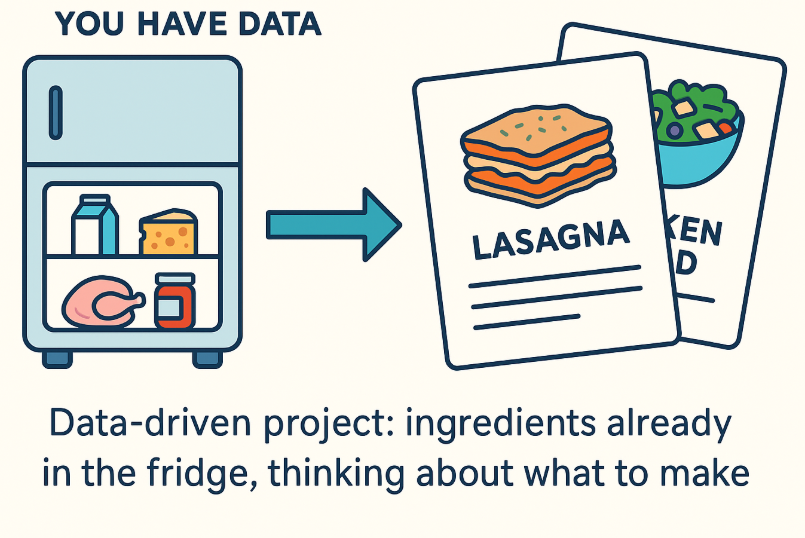
Every great data mining project starts with a fundamental choice, and a simple analogy from the kitchen can help you make the right one. Are you looking inside your fridge to see what you can make? Or do you already know you want lasagna? Understanding this distinction is the key to framing your project for success.

🎯 Learning Objectives
- Differentiate between data-driven (exploratory) and problem-driven (targeted) approaches.
- Recognize the best scenarios, pros, and cons for each method.
- Learn how to justify the business value of your project to get it deployed.
- Identify which approach best fits a real-world business problem.
Approach 1: The "What's in the Fridge?" Method 🧑🍳
This is the data-driven or exploratory approach. You start with the data you already have (the ingredients in your fridge) and explore it to see what valuable insights or patterns you can uncover.
When to Use It:
- When you're aiming for innovation and want to discover unknown opportunities.
- When your company has a large, underutilized dataset and wants to monetize its data assets.
- When the business goal is broad, like "find new ways to improve customer experience."
How to Justify Its Business Value:
Because the outcome is unknown, you must focus on demonstrating potential with minimal risk. Propose a short, time-boxed Proof of Concept (PoC) to show stakeholders the "art of the possible" with the data you have. Frame it as a low-cost exploration to unlock high-potential opportunities.
Approach 2: The "I Want Lasagna" Method 🛒
This is the problem-driven or targeted approach. You start with a specific business problem you need to solve (you know you want lasagna). Then, you go out and find the specific data required to solve it (you go shopping for the ingredients).
When to Use It:
- When you need to solve a specific, known business problem (e.g., "customer churn is up 15%").
- When a project's success can be tied directly to improving a Key Performance Indicator (KPI).
- When stakeholders need a predictable outcome and a clear return on their investment.
How to Justify Its Business Value:
This is more straightforward. Build a strong business case with a calculated Return on Investment (ROI). Show exactly how your project will either save money (e.g., by automating a process) or generate revenue (e.g., by identifying high-value leads). Highlight the cost of inaction—the money the business loses every day by not solving this problem.
💡 Key Takeaways
- "Fridge" Approach (Exploratory): Starts with data. Best for innovation. Justify with a Proof of Concept (PoC).
- "Lasagna" Approach (Targeted): Starts with a problem. Best for solving known issues. Justify with a calculated ROI.
- Your chosen approach determines how you will frame the project's value, scope, and potential outcomes to get stakeholder buy-in.