Statistical Quality Control Storytelling

The Midnight Bakery Part Two

A polished web edition of The Night Watchers story, covering variation, control charts, p-charts, c-charts, X-bar and R charts, process capability, and acceptance sampling through Luna's late-night bakery world.

Chapter 13 Study GuideBCOR440 / IE425Statistical Quality Control Fairy Tale

What students learn in this story

Part Two moves Luna from finding quality problems to monitoring them statistically. The Night Watchers help her distinguish natural variation from assignable causes, choose the right chart, judge process capability, and decide when incoming lots should be accepted or rejected.

VariationCommon variation is built into the process; assignable variation signals a specific cause.
Control ChartsCenter lines and control limits help detect when the process has changed.
Attribute vs. Variable Datap-charts and c-charts differ from X-bar and R charts because they answer different quality questions.
Capability & SamplingStable is not enough; the process must also meet specification and supplier quality needs.
Visual Navigation

Jump by chapter image

These illustrated chapter cards make the story easier to scan and navigate while keeping the same Midnight Bakery visual tone.

Chapter Twelve-and-a-Half

Previously, at the Midnight Bakery

Part One recap

Luna already learned how to map her process, gather data, prioritize the vital few, trace root causes, remove waste, organize her workspace, and mistake-proof the kitchen.

But Part Two begins with a new warning from her grandmother: seeing problems is not enough. Luna now needs guardians who watch every batch, every measurement, and every sign of trouble before it reaches the customer.

Chapter One

The Two Faces of Variation

Common vs. assignable

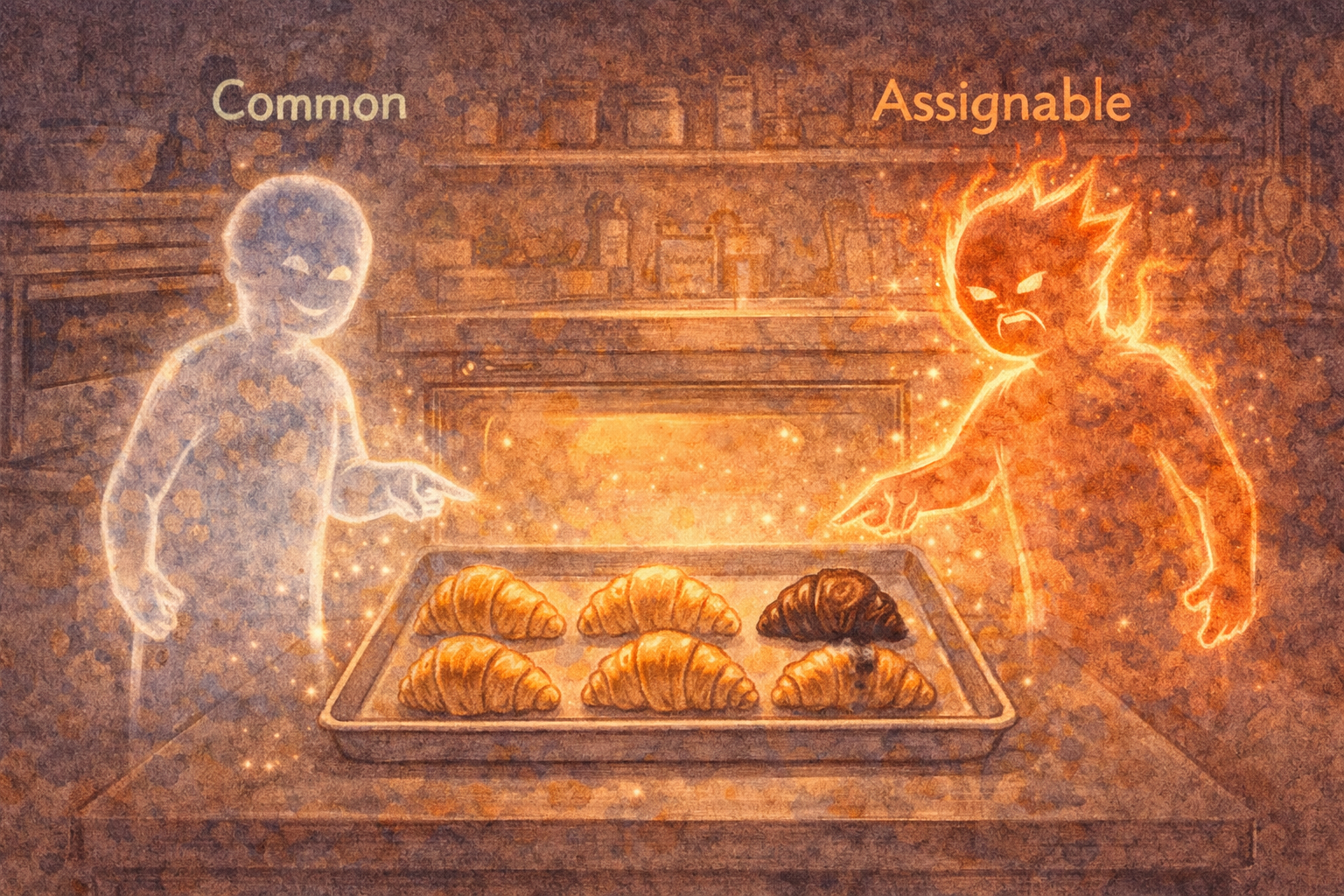
The first Night Watchers appeared as twins: Common Variation and Assignable Variation. One represented the natural, unavoidable randomness built into the process. The other represented specific, fixable causes like bad flour, a broken thermostat, or poor training.

Common Variation: "Those slight size differences? Me. Normal. Don't chase them."
Assignable Variation: "But those burnt ones? That's me. Something specific caused that. Find it."
Chapter Two

The Magical Scrolls - Control Charts

Control limits and signals

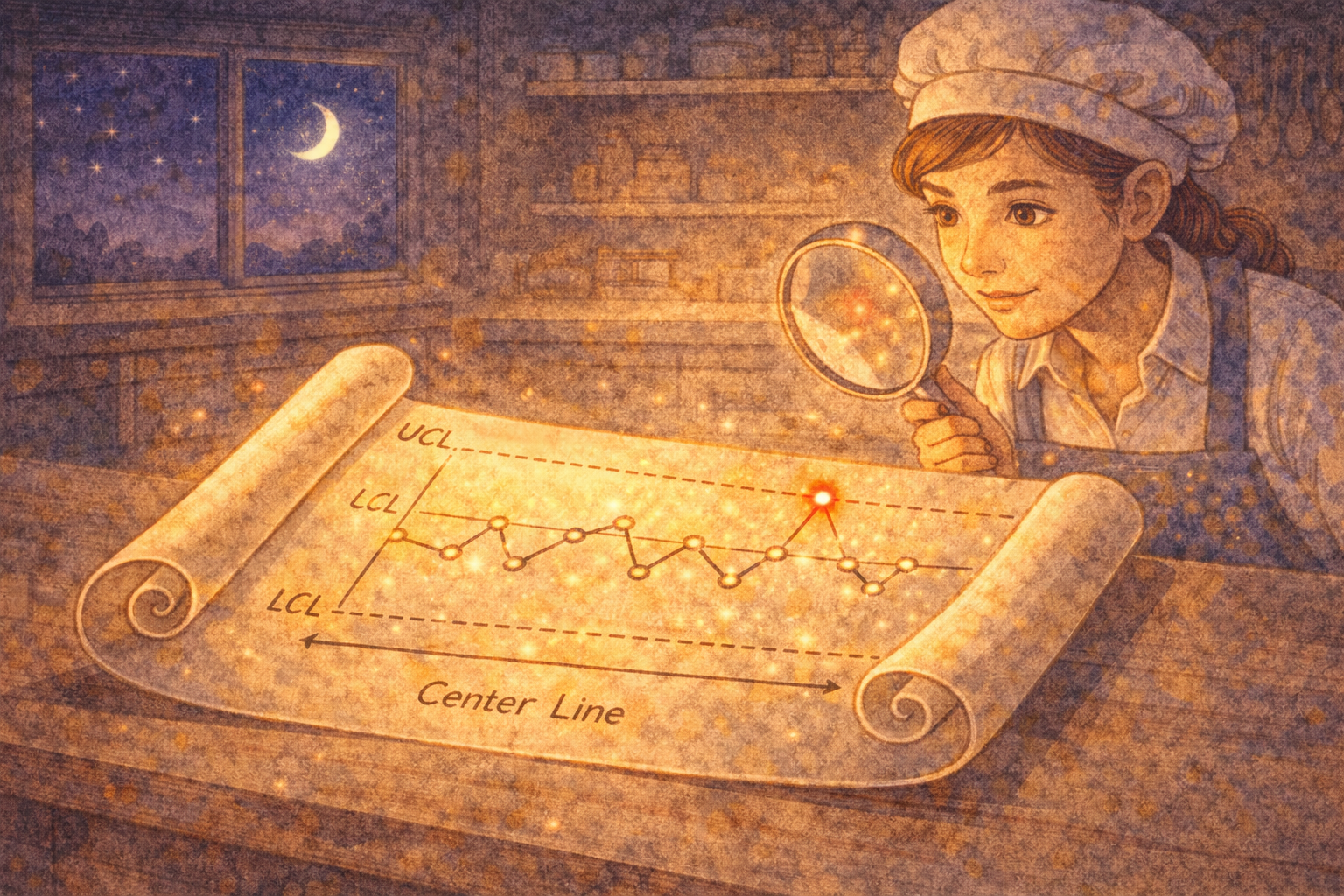
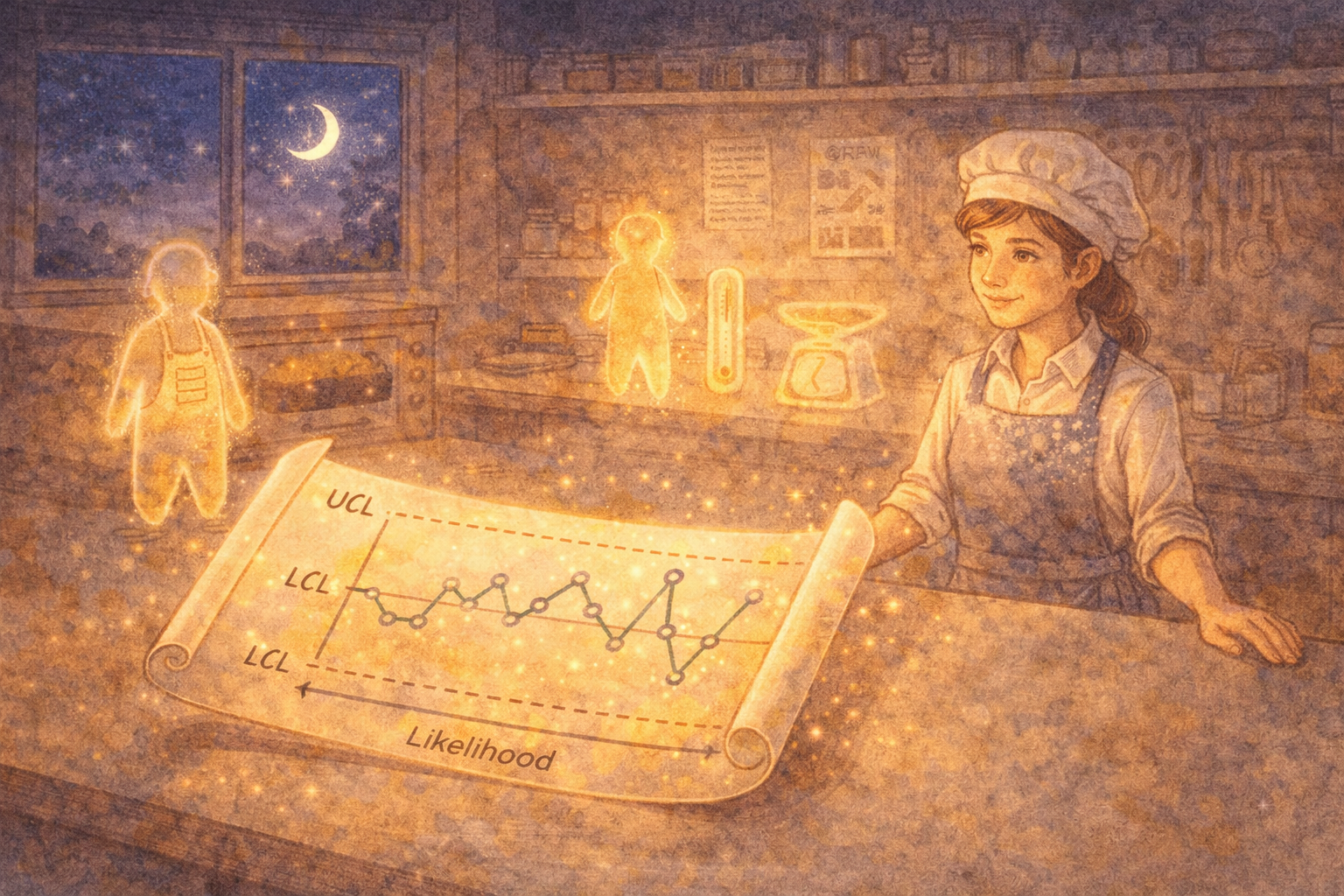
The twins unrolled a glowing control chart with three horizontal lines: the center line, the upper control limit, and the lower control limit.

As long as the process points stayed within the limits and did not form suspicious patterns, the bakery remained in control. But if a point crossed a limit or behaved strangely, the Watchers signaled that something specific had changed.

Chapter Three

The Inspector - p-Charts for Attribute Data

Defective or not

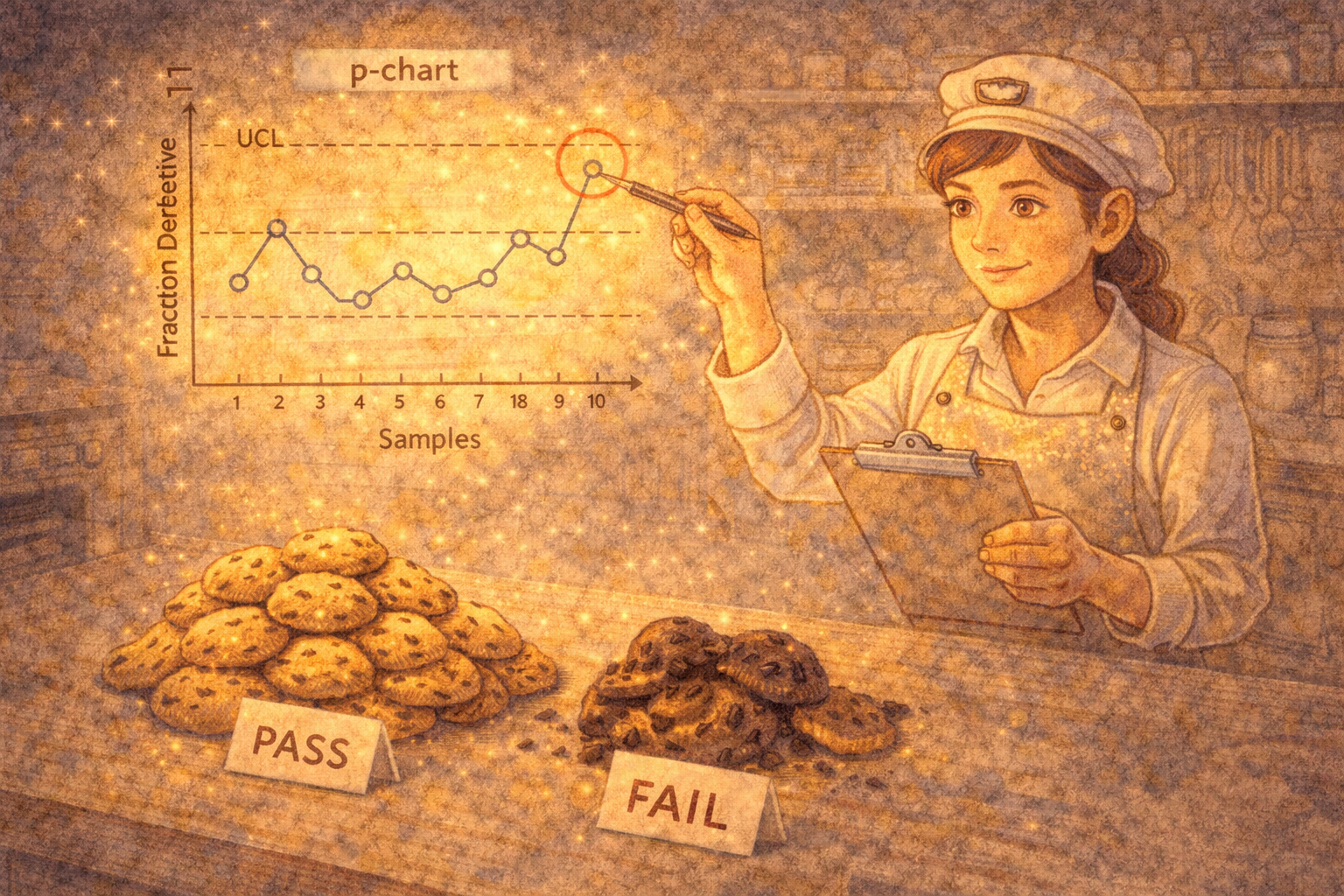
The Inspector handled attribute data: questions with two possible answers, such as pass or fail, cracked or not cracked, late or on time.

Using a p-chart, she tracked the fraction defective across bakery trays. When one tray's defect rate jumped above the upper control limit, Luna had an out-of-control signal and a clear reason to investigate.

What the p-chart answers

It does not count how many flaws one unit has. It tracks what proportion of inspected items are defective.

Chapter Four

The Counter - c-Charts for Counting Defects

How many flaws

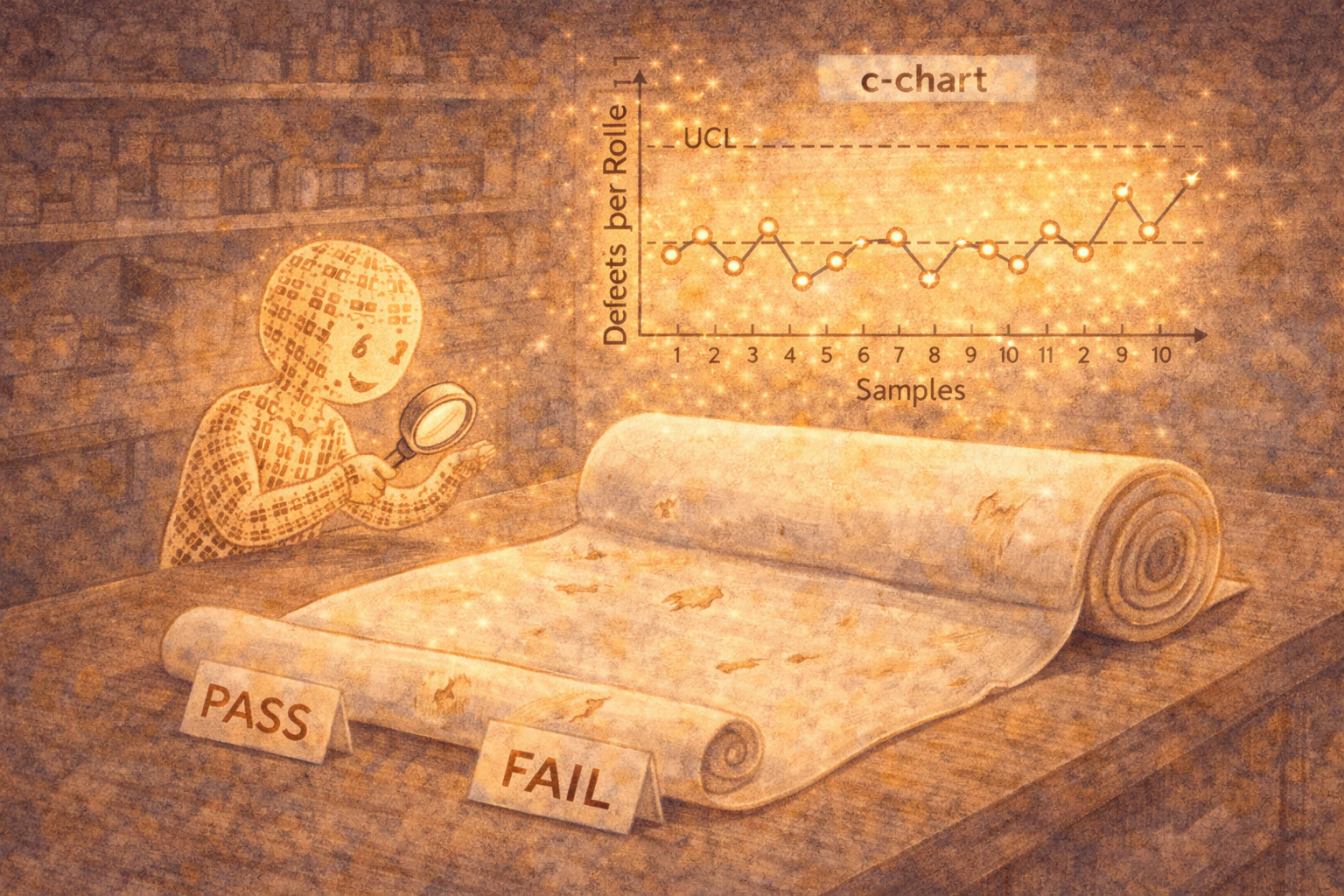
The Counter asked a different question: not whether an item was defective, but how many defects a single item contained.

This was the logic behind the c-chart. A fondant sheet might still be considered one unit, but it could contain multiple tears, discolorations, or weak spots. The c-chart tracks the count of defects per unit.

Chapter Five

The Precision Twins - X-bar and R Charts

Variable data

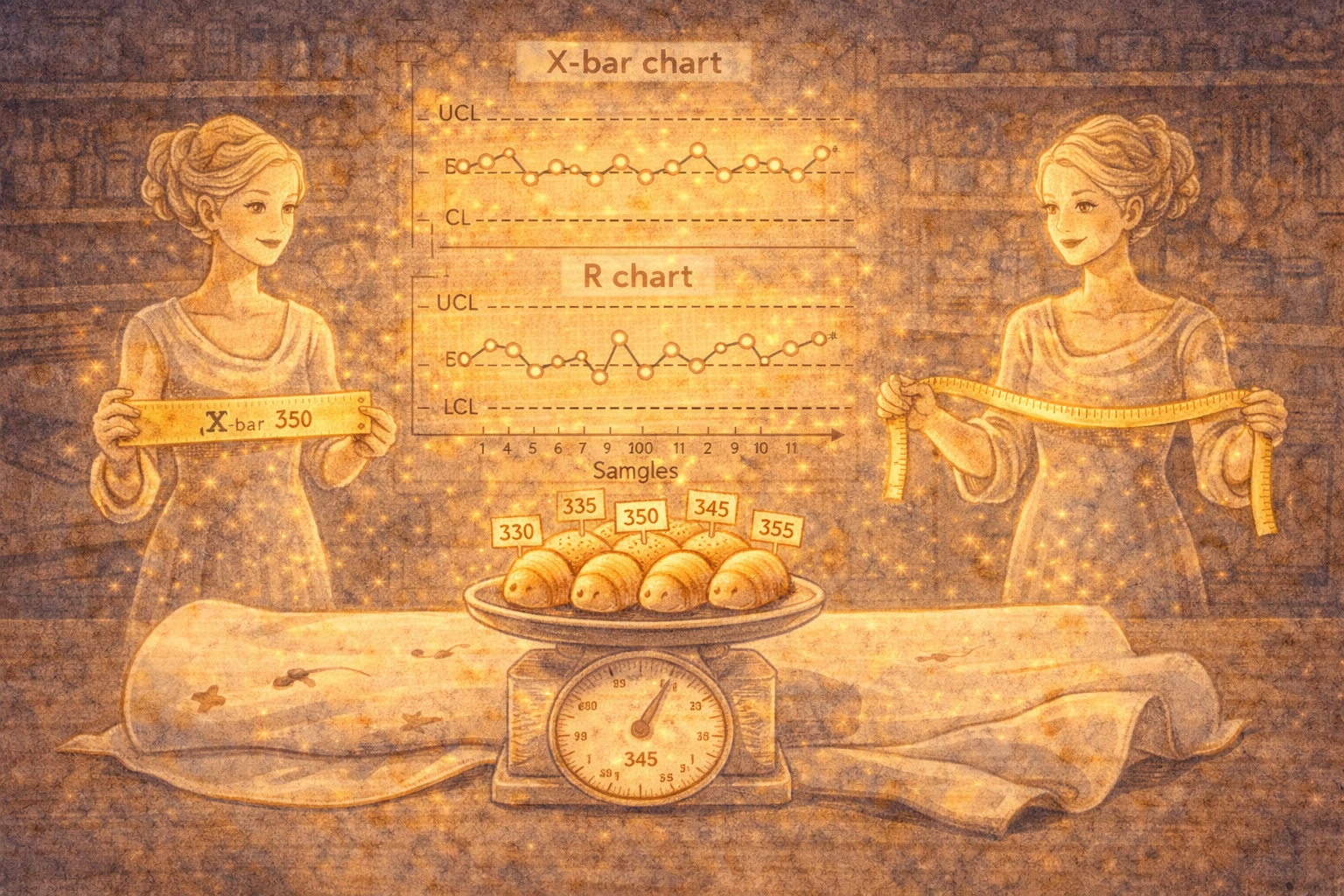
X-bar and R worked with variable data, meaning actual measurements such as weight, temperature, and length.

X-bar tracked the sample average over time, while R tracked the sample range. Together they helped Luna judge whether the process was centered correctly and whether the within-sample spread stayed consistent.

X-bar: "We measure, not just classify."
Chapter Six

Reading the Signs - Interpreting Control Charts

Patterns matter too

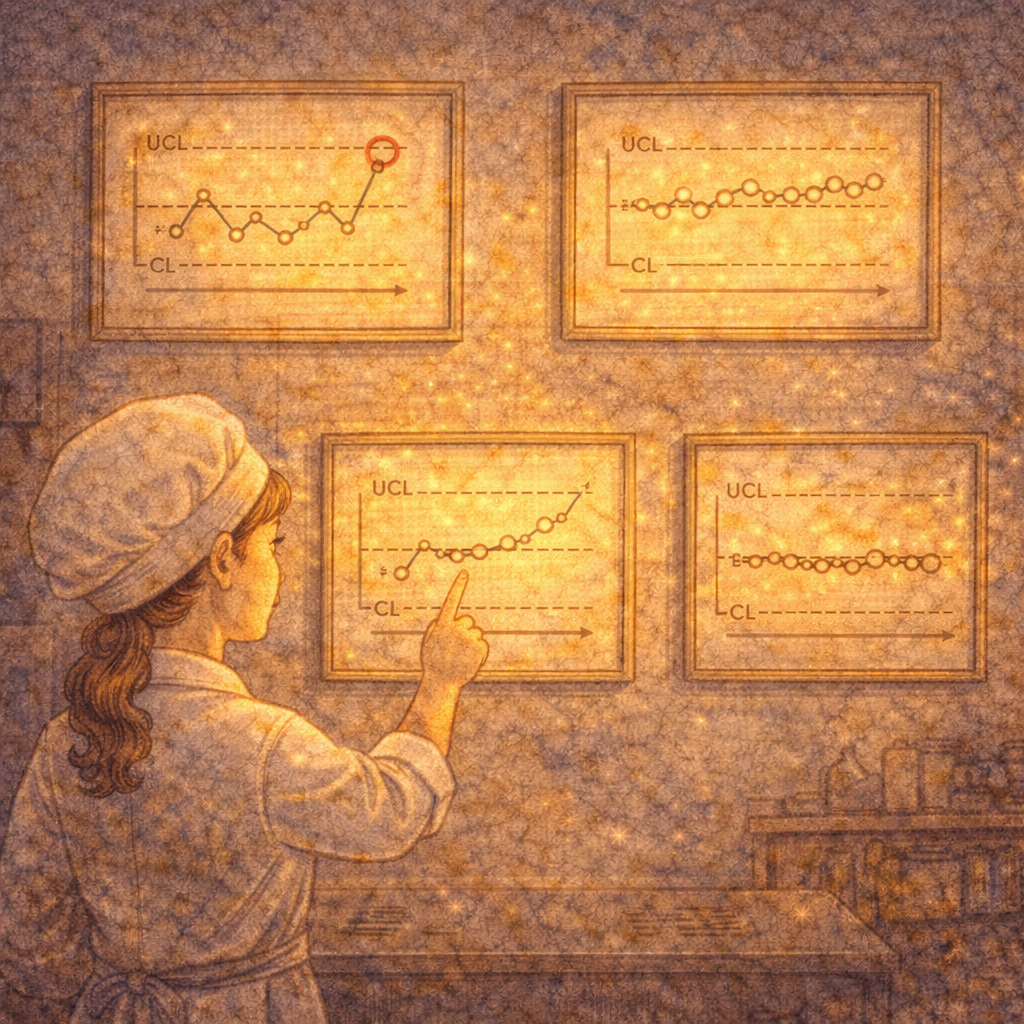
An out-of-limit point is the most obvious warning, but Luna also learned to watch for subtler patterns.

  • A single point outside the UCL or LCL.
  • A run of seven or more points on the same side of the center line.
  • A trend of seven or more steadily rising or falling points.
  • Points hugging the center line suspiciously closely.

Even if all points are technically inside the limits, the pattern may still reveal that the process has changed.

Chapter Seven

The Gatekeeper - Process Capability

Stable vs. good enough

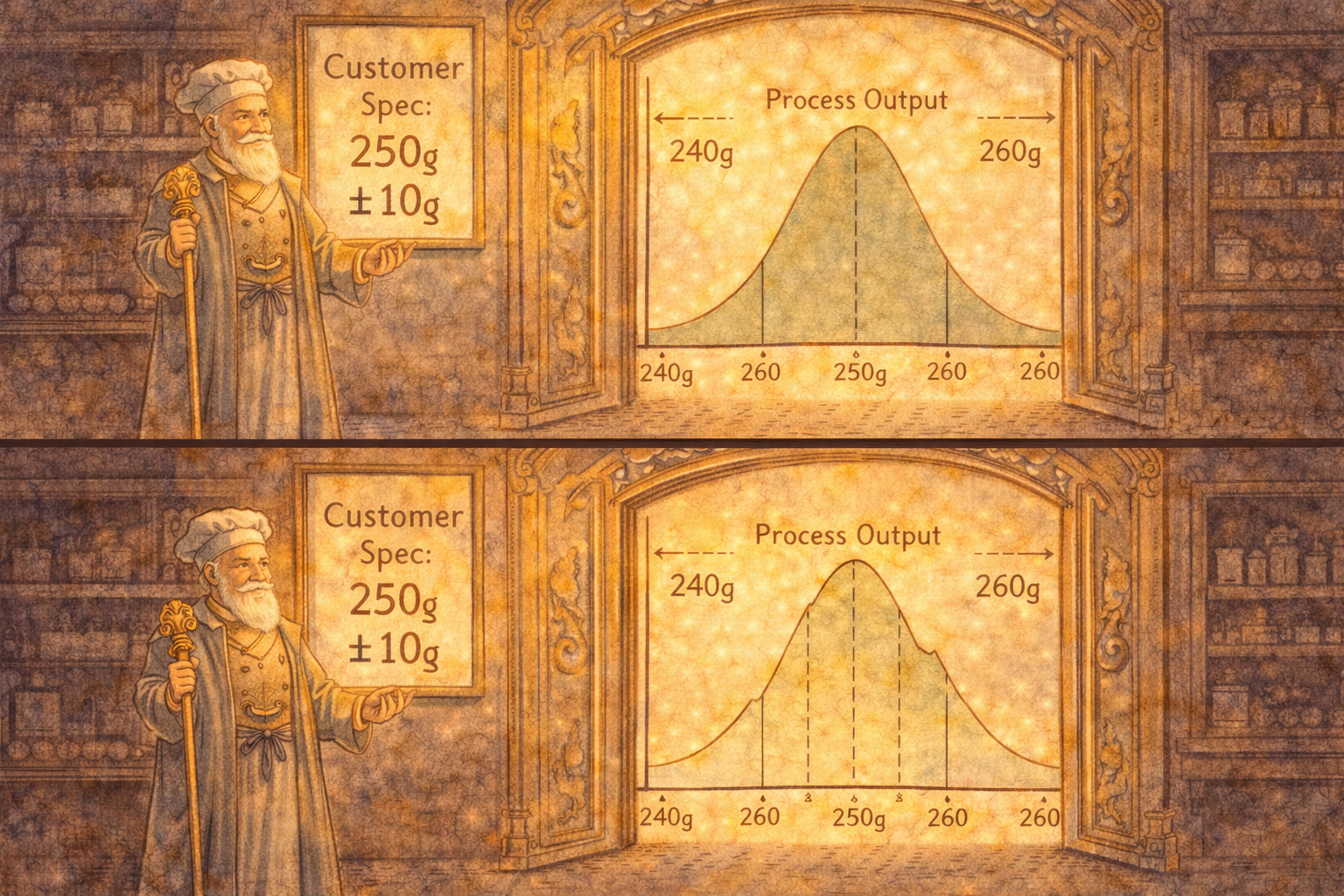
The Gatekeeper taught Luna that a stable process is not automatically a capable one. Control charts tell whether the process is in control. Capability asks whether it consistently meets customer specifications.

Luna's loaf-weight process had a Cpk of 1.00, meaning it was just barely capable. The process was on the edge and would need tighter control or better centering to create more margin.

Chapter Eight

The Shipment - Acceptance Sampling

Inspecting incoming lots

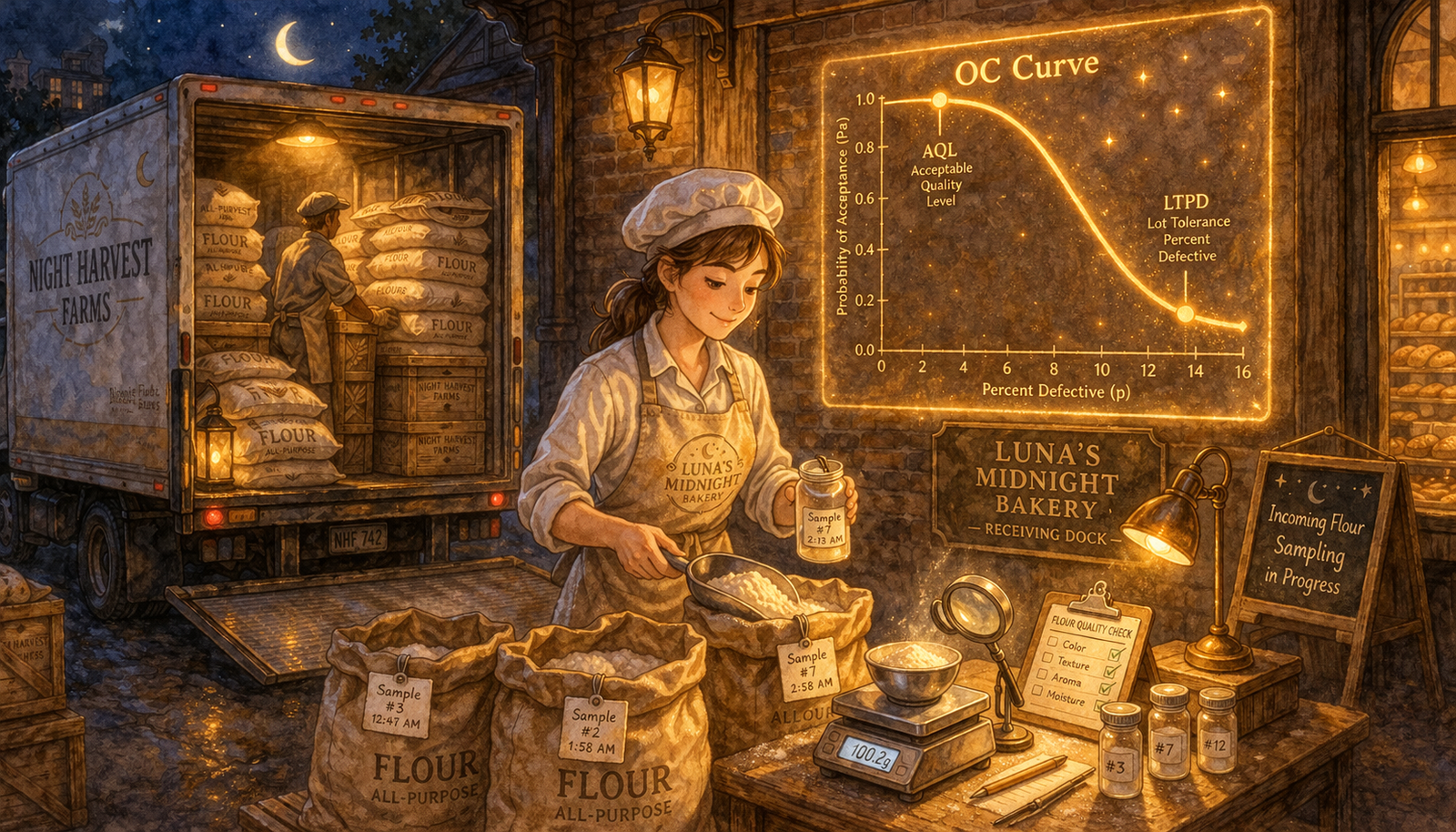
When a shipment of 5,000 flour bags arrived, Luna could not inspect every one of them. Acceptance sampling let her inspect a subset and then decide whether to accept or reject the full lot.

She learned how the sampling decision tied to concepts like AQL, LTPD, alpha risk, and beta risk, and how those values shape the sample size and acceptance number.

Chapter Nine

Choosing the Right Watcher - Which Chart When?

Tool selection

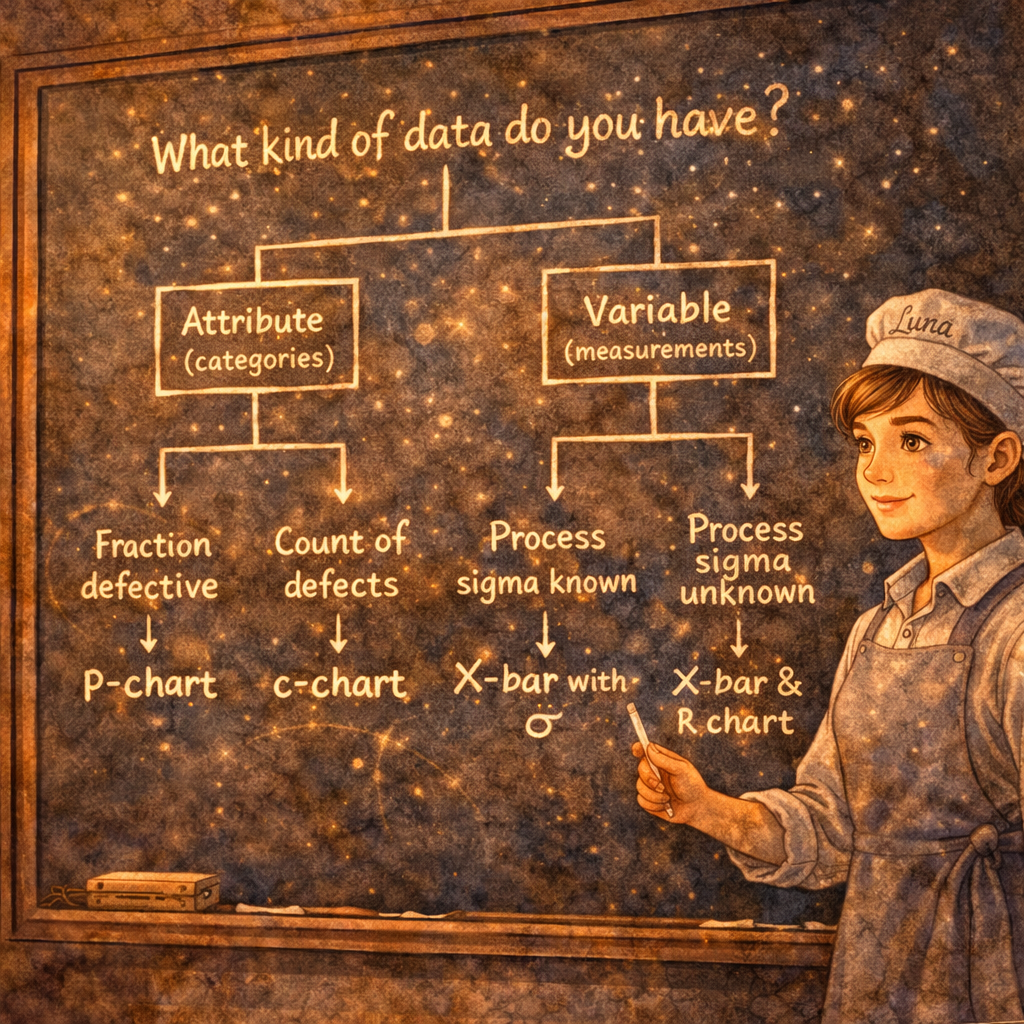
By dawn, Luna had many tools to choose from, and the real challenge became selection. The story resolves that confusion by showing that the correct chart depends first on the type of data and then on the question being asked.

Simple decision logic

Use p-charts and c-charts when you are classifying or counting defects. Use X-bar and R charts when you are measuring a variable characteristic like weight or temperature.

Chapter Ten

The Sunrise - Luna's Quality System

The system comes together

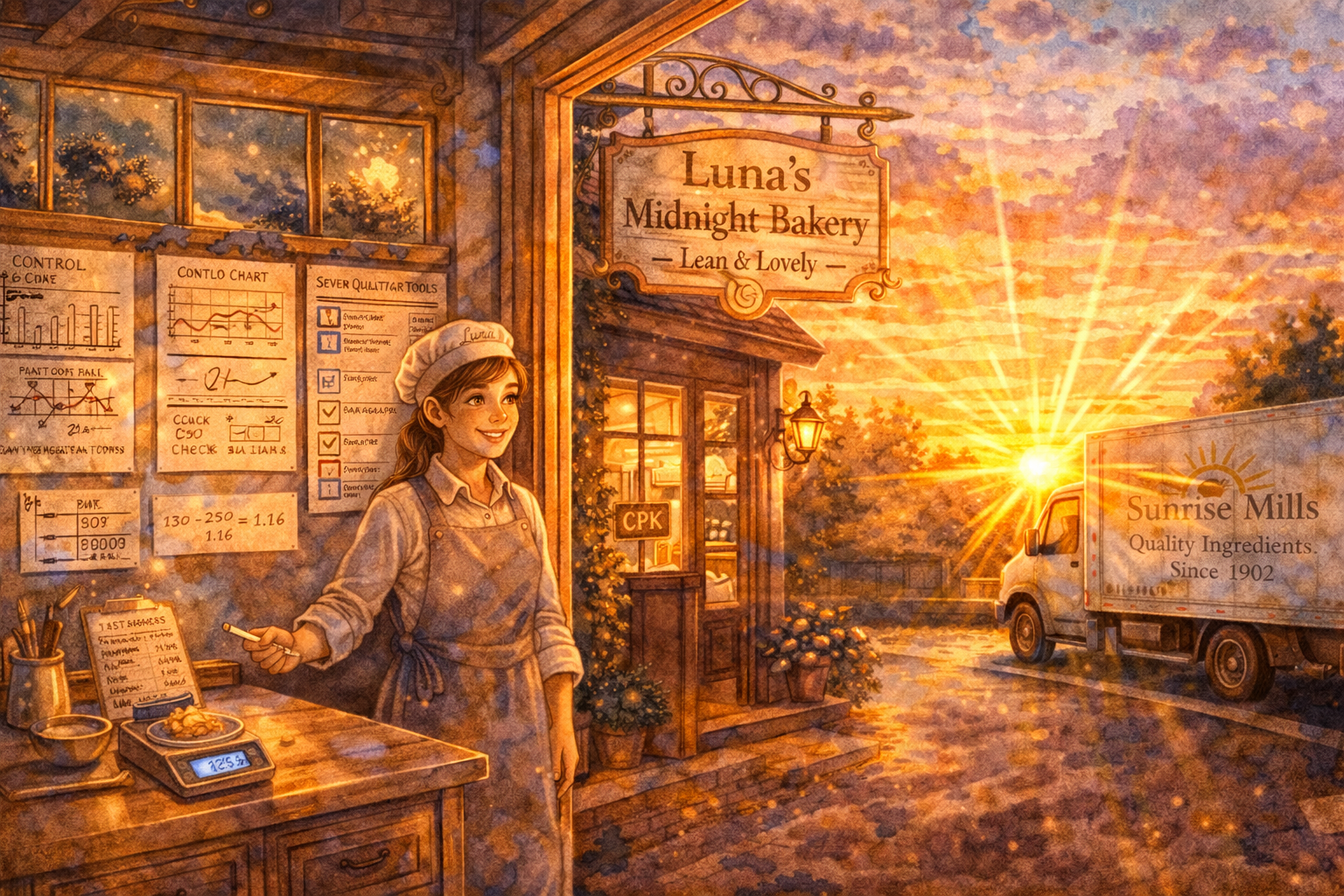
By sunrise, Luna had built a real quality system: p-charts for defective cookies, c-charts for fondant flaws, X-bar and R charts for loaf weight, a Cpk analysis for capability, and a sampling plan for supplier shipments.

"Not perfect. But in control. And capable."

The Night Watchers faded, but their charts remained. Luna would keep watching, and now she would know exactly what the process was trying to tell her.

Quick Reference

Use this section as the fast Chapter 13 study guide after the story. It condenses the Night Watchers into the concepts most likely to matter in class, review, and exam prep.

Two types of variation

Common variation: natural process noise that is always present.

Assignable variation: unusual variation caused by a specific, discoverable source.

Control chart basics

The center line shows the process average. UCL and LCL define expected statistical boundaries. Points outside limits or suspicious patterns signal loss of control.

p-chart

Use a p-chart when you care about the fraction defective in each sample. It answers a yes-or-no defect question at the item level.

c-chart

Use a c-chart when you need to count the number of defects on a single unit, even if that unit may still pass or fail separately.

X-bar and R charts

Use these when you are measuring a variable characteristic. X-bar tracks the sample average, and R tracks the sample range.

Out-of-control patterns

Watch for points outside limits, long runs on one side of center, sustained upward or downward trends, and suspiciously center-hugging patterns.

Point outside limitsRunTrendHugging

Process capability

Capability asks whether a stable process can meet customer specification limits. Cpk helps judge how well centered and tight the process is relative to those limits.

Acceptance sampling

Use a sample of the incoming lot to decide whether to accept or reject the full shipment. Key terms include AQL, LTPD, alpha, and beta.

Chart selection logic

Start with the data type. If you are classifying or counting defects, use attribute charts. If you are measuring a variable, use X-bar and R style charts.