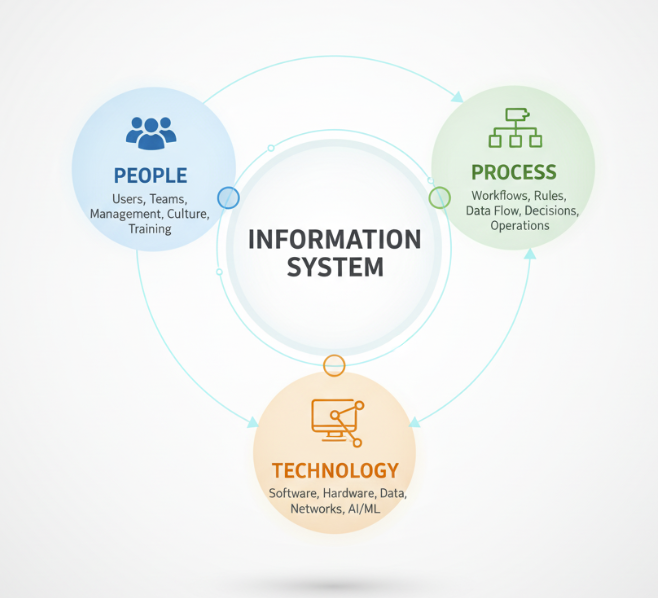
As managers, it's easy to view Artificial Intelligence as just another piece of software—a productivity tool to be deployed for efficiency gains. But this view is critically limited. True AI leverage comes from understanding it as a transformative force that reshapes the three core pillars of any business operation: People, Process, and Technology. A successful AI strategy isn't just about adopting new tech; it's about creating a new, symbiotic relationship between human talent, operational workflows, and intelligent systems.
👤 The People Component: Empowering Your Team
The single most important factor in AI adoption is your people. If your team sees AI as a threat, a complex burden, or a tool designed only to squeeze more out of them, they will not adopt it. The goal is to frame AI as a tool to "make work better".
From Productivity to Joy
Instead of focusing solely on "productivity," which can signal to employees that they'll be asked to do more with less, frame AI's purpose around removing "toil"—the repetitive, draining, and unfulfilling tasks that consume their day. By automating the "soul-sucking admin work," you free up your team to focus on tasks that bring them joy, mastery, and a sense of accomplishment. This employee-centric approach is the key to unlocking motivation and real engagement.
The New Skillsets
AI is changing the definition of valuable skills. The need for basic coding is diminishing, as AI can handle simple, repetitive programming tasks. The real value is shifting towards software engineering: understanding complex architecture, ambiguous requirements, and system governance. As a manager, your role is to foster an environment of continuous learning, helping your team transition from task-doers to problem-solvers who can architect and manage complex, AI-driven systems.
Manager's Action Plan: People
- Co-create Solutions: Don't just push tools onto your team. Involve them in the process. Ask them what their biggest "toil" is and co-create an AI solution with them.
- Lead by Example: Use the AI tools yourself. When leaders model the behavior—including the struggles of learning—it triples adoption rates among their teams.
- Carve Out Time for Learning: Employees often don't adopt new tools because they are buried in their current backlog. You must provide dedicated time and space for them to learn and experiment without penalty.
⚙️ The Process Component: Redefining Workflows
AI doesn't just speed up existing processes; it fundamentally changes how work gets done. Forward-thinking companies are moving beyond using AI for simple human augmentation and are starting to integrate AI agents as core members of their teams.
Meet Your New Digital Coworker
An AI agent is not just a chatbot; it's an autonomous system that can receive a task, execute it, and deliver a finished result for human approval. These "digital workers" can handle entire workflows like software testing, documentation, and even fixing simple bugs. As a manager, you can begin to think of your team composition as a mix of humans and agents, for example, "three humans and 27 agents".
From Rigid Rules to Intelligent Decisions
Traditional business processes are built on rigid, procedural logic ("if this, then that"). AI agents, however, operate on non-deterministic models. This means you can replace a 20-page document of if-then-else statements with a simple two-prompt instruction to an AI agent. This allows for more fluid, intelligent, and adaptable business processes that can handle ambiguity far better than legacy systems.
💻 The Technology Component: Building a Unified Strategy
While the technology itself is powerful, the strategy behind its implementation is what determines success or failure. This involves rethinking team structures and recognizing that adoption, not the tech itself, is the biggest hurdle.
The Rise of the "T-Shaped" Professional
In the past, developers, infrastructure teams, and data scientists worked in separate silos. This is no longer sustainable. AI requires a unified approach. The most valuable professionals are becoming "T-shaped": they possess a broad understanding across multiple domains (development, data, infrastructure) and deep expertise in at least one. As a manager, you should encourage cross-functional collaboration and training to break down these silos.
The Adoption Checklist
The technology can work perfectly, but it's useless if no one uses it. The key challenge is adoption. A proven checklist for driving adoption includes:
- Leaders must use it, love it, and talk about it. Endorsement from the top is non-negotiable.
- Be radically employee-centric. Use data to understand what brings your employees joy versus toil, and co-create solutions with them.
- Provide time and space to learn. Acknowledge the learning curve and build it into your team's workflow.
Key Takeaways from the Experts
The concepts in this lesson are drawn from insights shared by industry leaders. Watch these talks to go deeper.
Humans, Partnerships & AI Agents: Is Your Enterprise Ready?
with Miha Crawl, CTO at IBM Consulting
- AI Agents as Teammates: Progressive companies are treating AI agents as digital members of the team, capable of executing entire tasks autonomously.
- The Skills Shift: The era of the simple "coder" is ending. The future belongs to "software engineers" who can architect complex systems, as AI automates basic coding.
- Convergence of Roles: The walls between developers, data scientists, and infrastructure are collapsing. The future requires "T-shaped" universalists who understand the entire ecosystem.
AI: More Than Just Productivity & Adopting Employee-Centric AI
with Debbie Lovich, Senior Partner at Boston Consulting Group
- Joy vs. Toil: Frame AI as a tool to eliminate "toil" (draining work) and increase "joy" (fulfilling work). Focusing only on productivity creates fear and kills adoption.
- Radical Employee Centricity: Use the same research tools on your employees as you do on your customers. Understand their needs, segment them (e.g., "lifers" vs. "launchers"), and tailor AI rollouts to them.
- Co-Creation is Key: Involve employees in designing how AI will be applied to their work. This builds ownership and ensures the tools solve real problems without removing the parts of the job people love.