Why History Matters in the AI Age
AI has revolutionized business over the past several decades, transforming from rule-based systems into creative, decision-making partners for managers. For those leading today’s enterprises, understanding the journey of AI helps make sense of the new tools now shaping strategic decisions and daily operations.
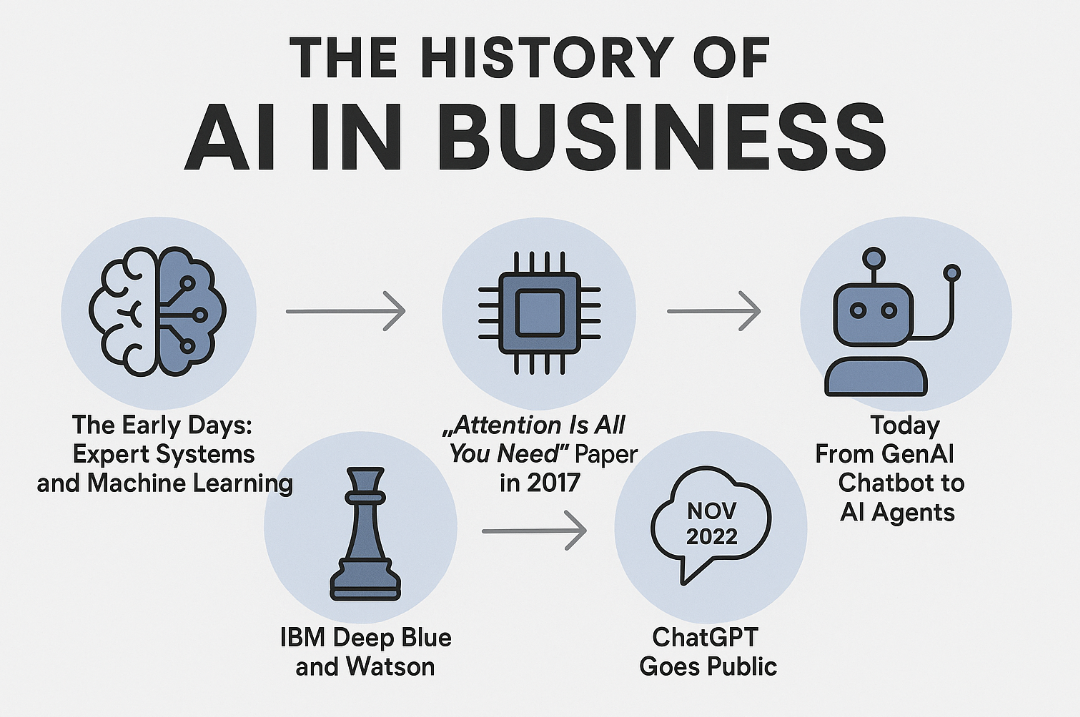
The Early Days: Expert Systems and Machine Learning
AI’s origins in business date back to the late twentieth century, when “expert systems” mimicked human reasoning in narrow domains such as medical diagnosis or financial forecasting. These systems used vast libraries of rules, but struggled with complex, ambiguous data. By the 1990s, machine learning emerged, allowing computers to learn patterns from data with minimal human intervention—laying important groundwork for analytics and automation.
Big Moments: IBM Deep Blue and Watson
IBM’s Deep Blue captured public attention in 1997 by defeating chess champion Garry Kasparov, showing that machines could master a game known for nuance and strategy. Over a decade later, IBM’s Watson won 'Jeopardy!', demonstrating that an AI system could understand language, synthesize knowledge, and deliver confident answers under pressure. These achievements showed managers that AI could tackle real-world business challenges, not just games.
The Transformer Revolution
A seismic shift occurred in 2017 when Google researchers published “Attention is All You Need,” introducing the transformer model architecture. This system was capable of handling vast amounts of information, recognizing context, and generating responses with previously unseen power. This laid the foundation for large language models (LLMs) and set the stage for generative AI tools that can write and summarize at scale.
Generative AI Goes Public: ChatGPT's Tipping Point
When OpenAI launched ChatGPT in November 2022, the business world witnessed a tipping point. Suddenly, generative AI capabilities like text creation, code writing, and analysis were accessible to everyone. Managers saw firsthand how AI could augment creativity and drive productivity in marketing, HR, customer service, and beyond.
Both Google and IBM had built advanced generative AI technologies but hesitated on public releases due to concerns about accuracy and business incentives. Once OpenAI proved a market existed, competitive pressure prompted every major tech player to bring their own tools to market.
Today: Agentic AI and Frontier Models
As of September 2025, managers confront a landscape of “frontier models” delivering not just generative capabilities, but **agentic AI**—systems able to act autonomously, carry out research, and execute multi-step tasks. This agentic approach is rapidly changing what it means to “delegate” to technology, reimagining workflow automation and strategic analysis for modern organizations.
Practical Takeaways for Managers
- AI adoption in business is a story of evolution: from rule-based systems to pattern-finding algorithms, generative creativity, and now autonomous agents.
- Today’s managers benefit most by staying agile, learning from AI’s past, and experimenting with new tools while maintaining practical skepticism toward their limitations and risks.
- The journey is ongoing; tomorrow’s AI partners may not just advise, but autonomously tackle business challenges—making it essential for leaders to keep learning and leading in tandem with their digital teammates.